Food delivery in Korea is everywhere. If you visit South Korea, one thing you may notice very quickly is how deeply delivery has become part of everyday life.
But Korean delivery culture is about much more than ordering pizza or takeout.
In Korea, you can order fried chicken, coffee, dessert, groceries, convenience-store items, and even everyday necessities through delivery apps. Some services can bring what you need within a very short time, making delivery feel less like a special service and more like part of everyday life.
So, what makes delivery culture in Korea different from the United States?
Food Delivery in Korea vs. the U.S.: What’s Different?
| Feature | 🇰🇷 South Korea | 🇺🇸 United States |
|---|---|---|
| How common is delivery? | Extremely common and deeply integrated into daily life | Common, but often used more selectively |
| Delivery distance | Even nearby restaurants can be easily ordered for delivery | Delivery often depends more heavily on distance and driver availability |
| Delivery speed | Fast delivery is an important part of the competition | Delivery times can vary considerably depending on traffic, distance, and driver availability |
| Delivery fees | Fees vary, and subscription programs can reduce or eliminate customer-facing delivery fees | Delivery fees, service fees, small-order fees, and other charges may apply |
| Tipping | Tipping is generally not expected for ordinary food delivery | Tipping is an established part of delivery culture |
| Housing | Dense apartment and urban housing makes centralized delivery relatively convenient | Housing types and delivery environments vary widely |
| Ordering | One app can combine restaurant search, ordering, payment, and delivery tracking | Apps such as DoorDash and Uber Eats provide similar functions |
| Late-night delivery | Late-night food delivery is relatively normal | Availability depends more on location and business hours |
| Types of delivery | Food, groceries, convenience-store items, and other everyday goods | Food delivery has expanded into grocery and retail delivery as well |
| Doorstep delivery | Very common | Common, but delivery instructions and access can vary by property |
The important point is that the U.S. also has a highly developed delivery market.
Companies such as DoorDash and Uber Eats now deliver not only restaurant food but also groceries and convenience items. In fact, DoorDash has continued expanding its food, grocery, and convenience-item delivery business.
So the difference isn’t that Americans don’t have delivery.
The difference is how deeply delivery has become embedded in everyday life in Korea, especially in dense urban areas.
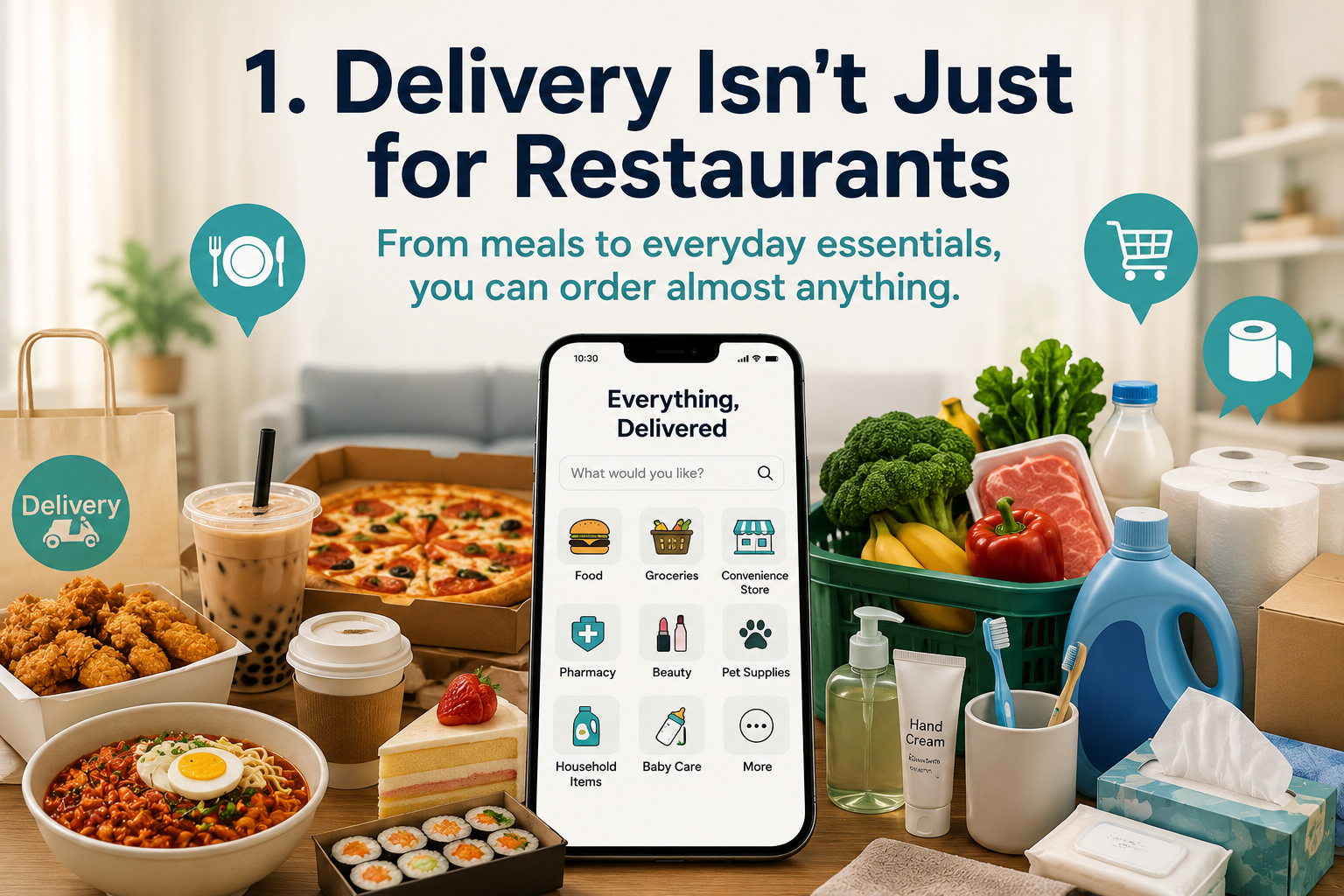
1. Delivery Isn’t Just for Restaurants
This may be one of the biggest surprises for foreigners.
In Korea, food delivery apps have expanded beyond restaurants into grocery shopping and everyday shopping.
For example, Baemin offers food delivery alongside grocery shopping and other shopping services. Its B Mart service provides groceries and everyday products through rapid delivery, while its shopping section includes food, household necessities, and other items.
That means you might not need to make a separate trip to a supermarket or convenience store just because you ran out of something.
Need some fruit? Order it.
Need snacks and drinks? Order them.
Forgot toilet paper or shampoo? Depending on your location and the service available, you may be able to have them delivered.
Some quick-commerce services even advertise delivery within an hour in eligible areas.
This is an important shift in the meaning of “delivery.”
It’s no longer simply:
“I don’t want to go to a restaurant.”
It can be:
“I don’t want to leave my home.”
2. You Can Order From Surprisingly Nearby Places
In many countries, delivery is most useful when you are ordering from a restaurant that is relatively far away.
In Korea, that’s not always the case.
Because Korean cities are densely populated and restaurants, cafés, convenience stores, and residential buildings are often located close together, delivery can make sense even for relatively short distances.
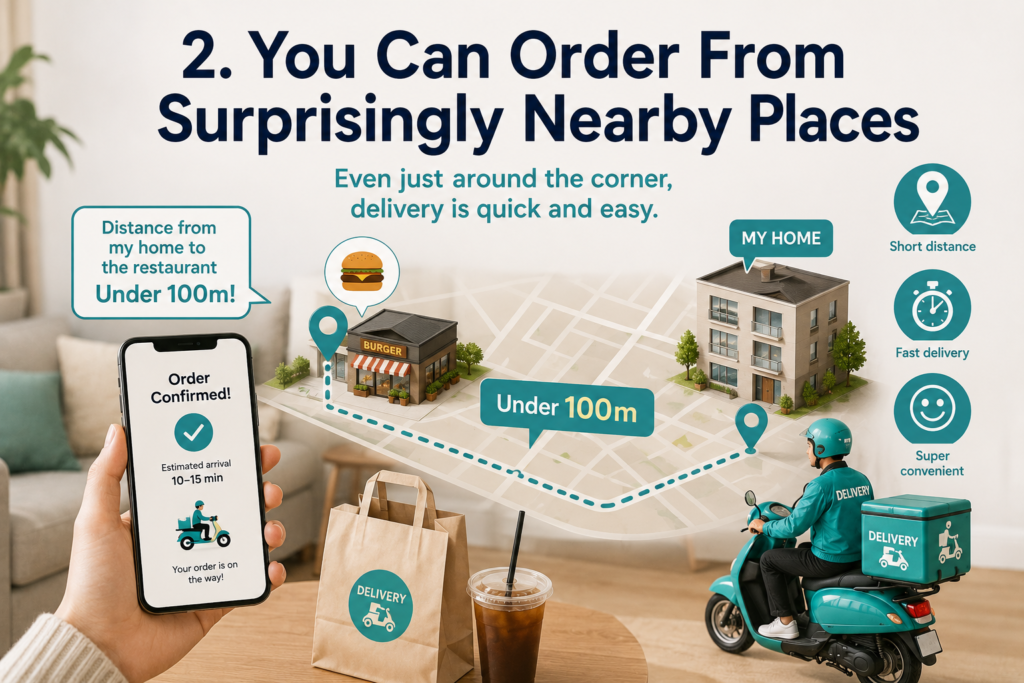
You might see a restaurant just a few minutes away and still order delivery.
For someone visiting from the U.S., this can feel unusual.
The question isn’t always:
“Is this restaurant far enough away to justify delivery?”
Instead, it can be:
“Why would I go outside when I can have it delivered?”
3. Speed Is Part of the Competition
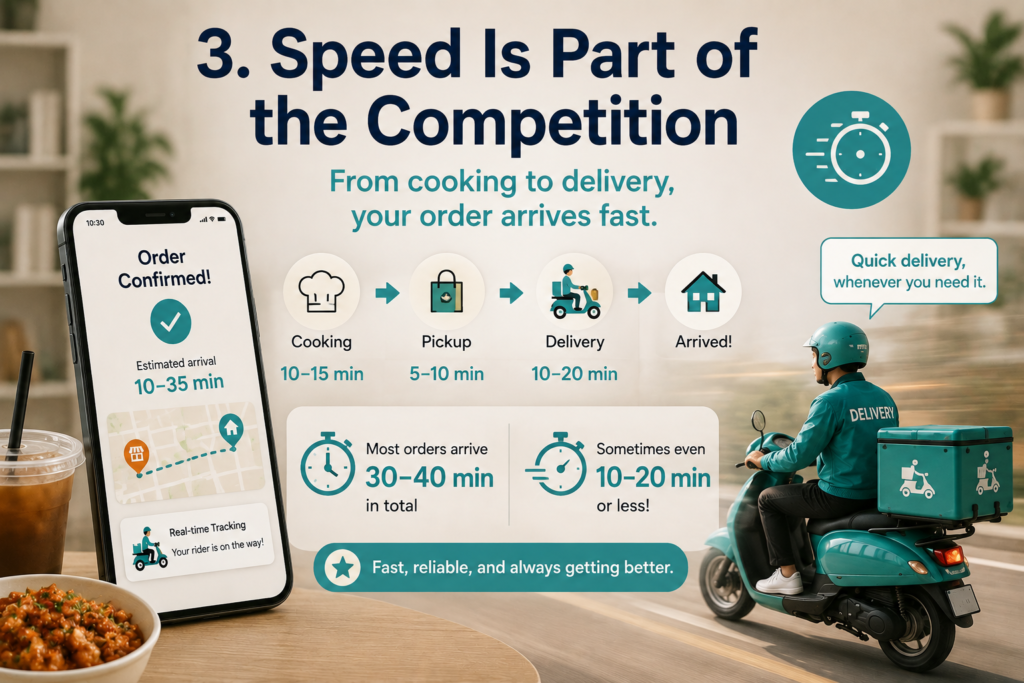
Fast delivery is another major part of Korean delivery culture.
Korean delivery platforms compete not only on restaurant selection and price but also on delivery speed and different delivery options.
Baemin, for example, promotes both single-order delivery and more economical delivery options.
This doesn’t mean every Korean delivery order arrives in minutes. Traffic, weather, restaurant preparation time, and courier availability still matter.
But speed itself has become an important consumer expectation.
A quick-commerce service such as B Mart even advertises delivery within one hour in eligible areas.
4. The Tipping Culture Is Very Different
This is one of the easiest differences for an American visitor to notice.
In the U.S., delivery orders can involve several different charges.
Depending on the service and location, customers may see a delivery fee, service fee, small-order fee, taxes, and a tip.
Uber Eats, for example, lists delivery fees, service fees, and small-order fees among the charges that may apply to an order.
Tipping is also an established part of American delivery culture.
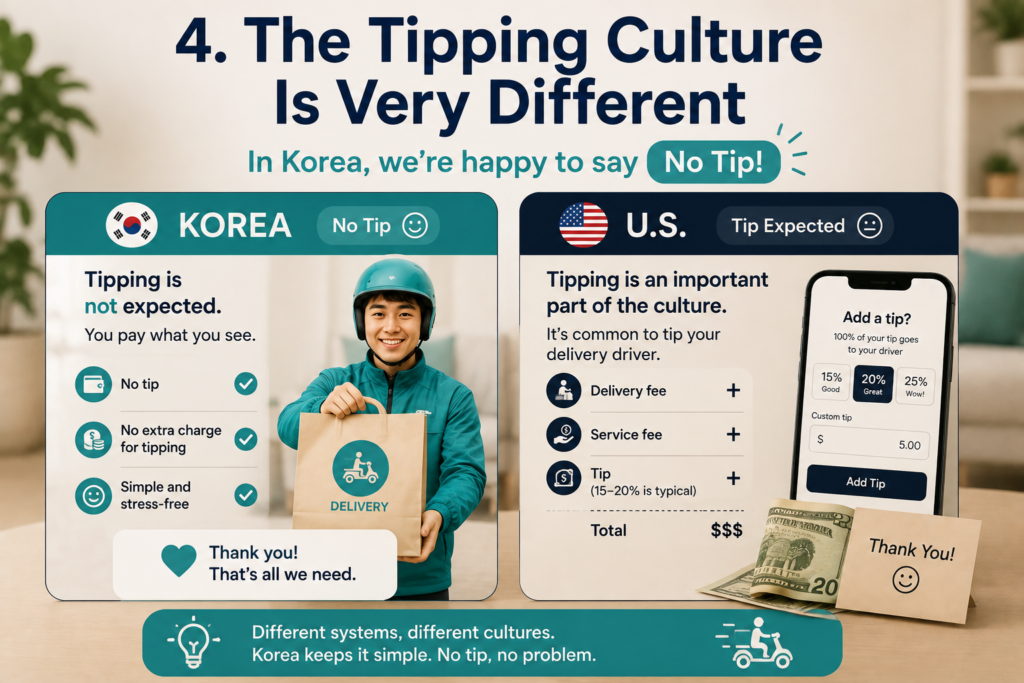
In Korea, tipping is generally not expected for ordinary food delivery.
That doesn’t mean Korean delivery is always cheap.
Delivery fees and platform costs have become an important issue in Korea too, and some services now use membership programs or promotions to reduce the delivery fee customers see.
For example, Baemin promotes a membership program with free delivery benefits on eligible orders.
So the two countries have different ways of distributing the cost of delivery.
5. Korean Delivery Extends Into Everyday Life
Perhaps the most interesting thing about Korea’s delivery culture is how many ordinary situations can involve delivery.
Imagine this:
You are at home late at night. You want a drink, some snacks, or something simple to eat.
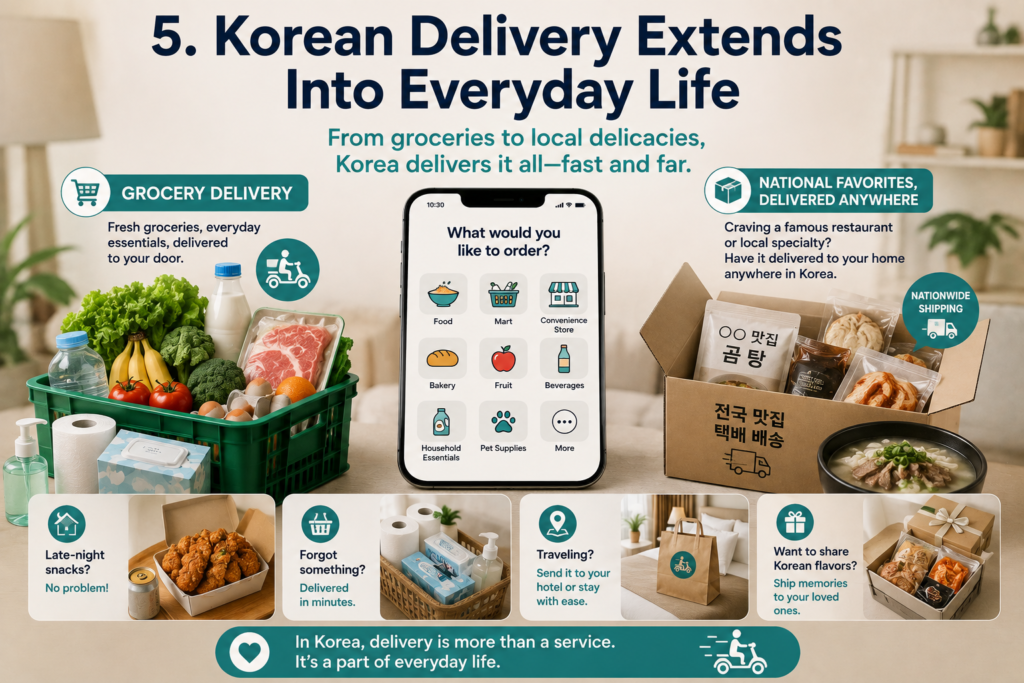
In many Korean cities, you don’t necessarily have to get dressed, drive somewhere, find parking, and go shopping.
You can simply open an app.
And it doesn’t stop with food.
Modern Korean delivery platforms increasingly connect restaurants, supermarkets, convenience stores, and other retail services in one digital environment.
Baemin currently describes its service as covering food, grocery shopping, and shopping, including everyday items.
This is why it may be more accurate to think of Korean delivery as part of the country’s convenience infrastructure rather than simply a restaurant service.
6. Why Did This Culture Develop So Strongly?
There isn’t one single reason.
Several factors work together.
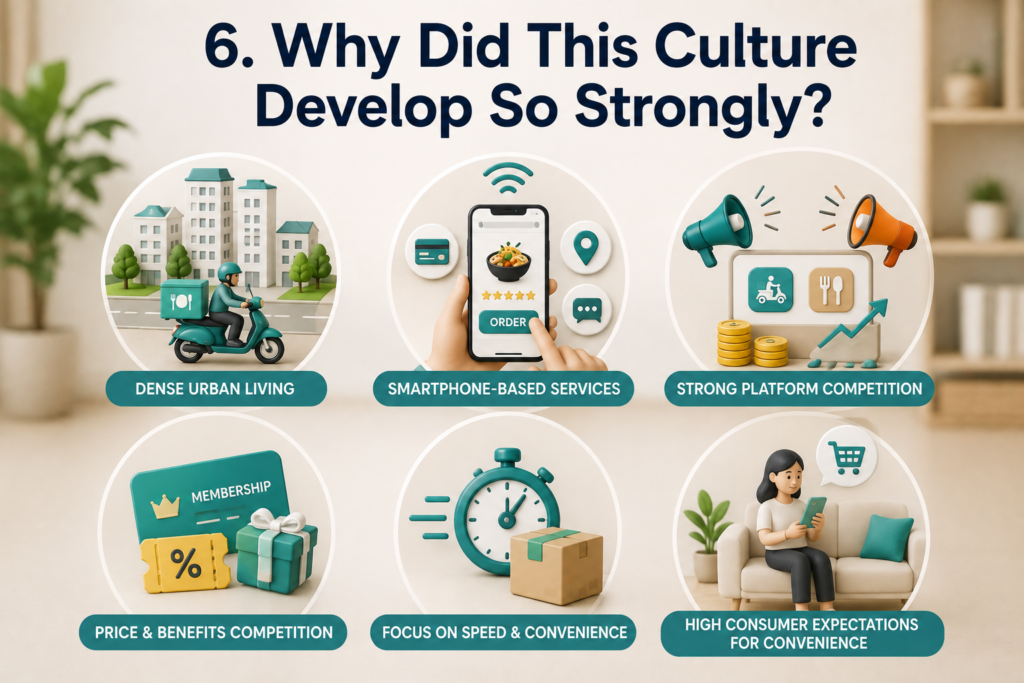
Dense Urban Living
South Korea has highly concentrated urban areas, especially around Seoul and other major cities.
Apartments are common, restaurants and shops are often located close to residential areas, and delivery routes can serve many customers within a relatively compact area.
Smartphone-Based Services
Ordering, payment, location sharing, delivery tracking, reviews, and customer communication can all happen through a smartphone.
Strong Competition Between Platforms
Delivery platforms compete on price, restaurant selection, promotions, membership programs, and speed.
Consumer Expectations for Convenience
Once people become accustomed to ordering almost anything from their phones, going to a store for every small purchase can feel unnecessary.
This convenience-driven behavior is also reflected in Korea’s broader online shopping market.
Statistics Korea reported that mobile shopping accounted for 76.4% of online shopping transactions in December 2024, while online food-service transactions increased 17.5% year over year that month.
Is Korean Delivery Really That Different?
The United States is also moving toward a world where food, groceries, and convenience items can all be delivered through apps.
So the gap is not as simple as “Korea has delivery and America doesn’t.”
The more interesting difference is how ordinary delivery feels in Korean daily life.
In Korea, delivery can be:
- Dinner after work
- Coffee in the afternoon
- Late-night snacks
- Groceries for tomorrow’s breakfast
- Convenience-store items you suddenly need
- Household necessities you forgot to buy
The physical distance between you and the store can become almost irrelevant.
And that’s probably the most interesting thing about Korean delivery culture:
Delivery isn’t always something you use because you can’t go somewhere. Sometimes, delivery is simply the easier way to live.
What Might Surprise an American Visitor Most?

If you’re visiting Korea for the first time, you might be surprised by how normal it feels to see delivery motorcycles throughout the city, how many types of businesses offer delivery, and how easily everyday purchases can be brought to your door.
And if you’re staying in a hotel or apartment, you may quickly discover that delivery is not limited to traditional restaurant food.
Once you experience it, you may find yourself asking a very Korean question:
“Why would I go out when I can just order it?”
Final Thoughts
Korea and the U.S. both have highly developed food delivery industries, but the role delivery plays in everyday life can feel very different.
In Korea, dense cities, apartment living, smartphone-based services, strong platform competition, and a high demand for convenience have helped make delivery a normal part of daily life.
For visitors, that’s what makes Korean delivery culture so interesting.
It’s not simply about getting food delivered faster.
It’s about how delivery can remove the need to make a trip at all.
Curious About Life in Korea?
If you’re curious about what everyday life is really like in Korea, check out more of our guides to Korean culture, food, shopping, travel, and everyday experiences.