It’s August in Korea, and something interesting has happened.
People have already started talking about autumn.
The strange part? It’s still hot. Very hot.
In Korea, the beginning of autumn is traditionally marked by a day called Ipchu (입추, 立秋). In 2026, Ipchu fell on August 7.
If you are visiting Korea or learning about Korean culture for the first time, you might naturally wonder:
Why does autumn begin in August when it still feels like summer?
The answer takes us back hundreds, and even thousands, of years to a fascinating way of understanding time, nature, and the changing seasons.
What Is Ipchu?
Ipchu literally means “the beginning of autumn.”
It is the 13th of the traditional 24 solar terms, a system that divides the year according to the sun’s annual movement.
In the traditional East Asian seasonal system, Ipchu marks the beginning of autumn and the transition from the traditional summer season toward autumn.
But this does not mean that the weather suddenly changes on August 7.
In fact, August is still one of the hottest months in Korea.
Instead, Ipchu represents a seasonal turning point—a marker that nature has begun its gradual movement toward autumn.
That idea is one of the most interesting things about Korea’s traditional calendar.
How Did People Divide the Seasons Long Ago?
Today, we can check the weather with a smartphone in seconds.
We know tomorrow’s temperature, the chance of rain, sunrise and sunset times, and even how the weather may change next week.
But imagine living hundreds of years ago without weather forecasts, satellites, thermometers, or smartphone apps.
How would you know when one season was changing into another?
People watched nature.
They observed the position of the sun, changes in temperature, rainfall, plants, crops, animals, and the length of daylight.
Over generations, these observations became a sophisticated way of understanding the rhythm of the year.
The 24 solar terms were developed from observations of the sun’s annual movement and were used to organize agricultural activities and everyday life.
The system originated in ancient China and later became part of the traditional calendars and agricultural practices of Korea and other parts of East Asia.
This is what makes the system so fascinating.
People were not simply saying, “Summer ends around August.”
They created a much more detailed map of the year.
The 24 Solar Terms: Dividing a Year Into 24 Seasonal Moments
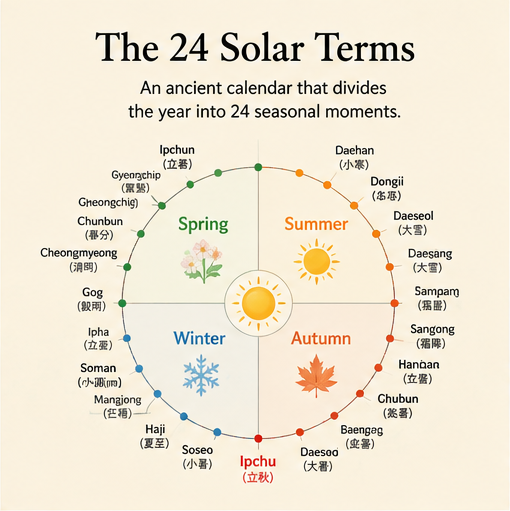
The traditional system divides the solar year into 24 points, each associated with a particular seasonal change.
Some names are surprisingly descriptive.
Ipchun (立春) means the beginning of spring.
Ipchu (立秋) means the beginning of autumn.
I pdong (立冬) means the beginning of winter.
Other terms describe things people might observe in nature.
Gyeongchip (驚蟄) is associated with creatures awakening from hibernation.
Usu (雨水) literally means “rainwater” and is associated with the time when snow and ice begin giving way to rain.
Baengno (白露) means “white dew,” referring to the appearance of dew as the seasons change.
The names themselves reveal something important.
The calendar was not only about counting days.
It was a way of reading nature.
The Wisdom Behind the Seasons
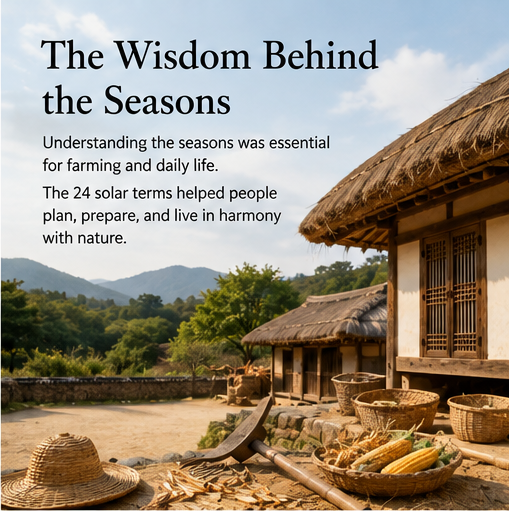
For people living in an agricultural society, understanding seasonal changes was not just interesting.
It was essential.
When should crops be planted?
When should they be harvested?
When would the weather become warmer?
When should farmers prepare for cold weather?
A few weeks could make a significant difference to a year’s harvest.
The 24 solar terms provided seasonal reference points that could help people organize agricultural work and other aspects of daily life.
In Korea, the system was adapted to local conditions and used as a practical seasonal framework.
Traditional Korean sources describe the four seasons as running from Ipchun to Ipha, from Ipha to Ipchu, from Ipchu to Ipdong, and from Ipdong to the following Ipchun.
In other words:
Spring → Ipchun to Ipha
Summer → Ipha to Ipchu
Autumn → Ipchu to Ipdong
Winter → Ipdong to Ipchun
This is different from simply dividing the year into three calendar months per season.
It is a seasonal system based on the movement of the sun and the natural cycle of the year.
But Does Korea Really Start Getting Cooler After Ipchu?
This is where things get interesting.
If you stand outside in Korea in early August, you probably won’t think:
“Ah, autumn has arrived.”
It can still be extremely hot and humid.
So why do Koreans still say that the season has changed?
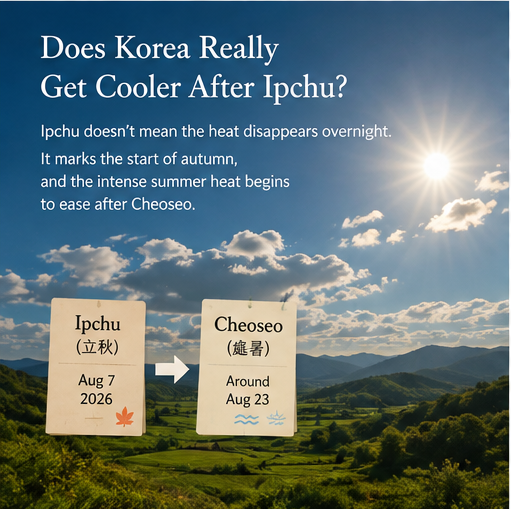
Because Ipchu is not a promise that the temperature will suddenly drop.
It is a traditional marker of a gradual transition.
There is even another solar term later in August called Cheoseo (처서, 處暑), which literally refers to the easing or ending of the summer heat.
Cheoseo comes after Ipchu, around August 23, and traditionally marks the point when the intense summer heat begins to subside.
So the traditional calendar actually gives us a surprisingly nuanced picture:
Ipchu: Autumn begins.
Cheoseo: The summer heat begins to retreat.
That makes much more sense when you think about how seasons actually work.
Nature rarely changes overnight.
Why Does It Feel Like Autumn Is Coming?
There is something strangely satisfying about noticing the seasonal change in Korea.
After the peak of summer, the days gradually become shorter.
The sun’s position changes.
Temperatures eventually begin to ease.
The air can feel different, especially in the mornings and evenings.
Then, almost imperceptibly, the landscape begins to change.
The traditional calendar recognized this gradual movement long before modern weather forecasting existed.
Of course, modern climate science gives us a much more precise understanding of why temperatures change.
But the basic human experience is surprisingly similar.
People thousands of years ago looked at the world around them and noticed that the season was changing.
They simply had different tools for describing it.
Korea’s Four Seasons
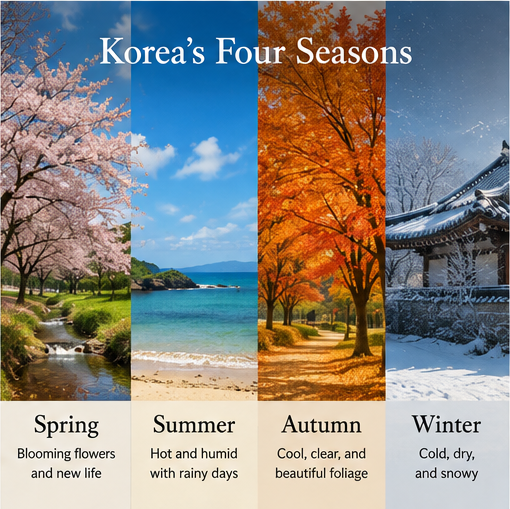
One of the things many visitors notice about Korea is that the country has four distinct seasons.
Spring
Spring in Korea generally brings gradually warming temperatures, blooming flowers, and new growth.
It is also the season associated with Ipchun, the traditional beginning of spring.
Summer
Summer is hot and humid, with a rainy season occurring during part of the summer.
July and August can be particularly hot.
This is why it can feel slightly strange to hear Koreans talking about autumn in early August.
Autumn
Autumn brings cooler temperatures, clearer skies, and colorful foliage.
For many people, it is one of the most beautiful seasons to experience in Korea.
The traditional autumn season begins with Ipchu and continues until Ipdong, the beginning of winter.
Winter
Winter in Korea can be cold and dry, with snow occurring in many regions.
The traditional beginning of winter is marked by Ipdong, which usually falls in early November.
What I Find Fascinating About Ipchu
What I find most fascinating about Ipchu isn’t simply that Koreans have a traditional name for the beginning of autumn.
It’s the fact that people long ago tried to understand the world by carefully watching it.
They didn’t have weather apps.
They didn’t have satellites.
They couldn’t open a calendar on their phones and see the season changing.
They watched the sun.
They watched the sky.
They watched plants and crops.
They noticed changes in temperature, rain, and daylight.
And over generations, those observations became a system that divided the year into 24 meaningful seasonal points.
That’s a remarkable example of how much knowledge can come from simply paying attention to nature.
Ipchu in Modern Korea
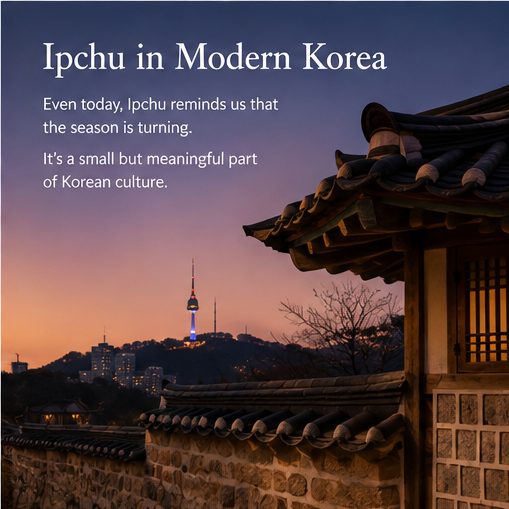
Today, most Koreans don’t use the 24 solar terms to decide when to plant crops or plan their daily schedules.
Modern calendars, weather forecasts, and scientific measurements have replaced most of their practical functions.
But the terms haven’t disappeared.
People still recognize words such as Ipchun, Ipchu, and Cheoseo, and they remain part of Korean cultural vocabulary.
You may even hear someone say:
“It’s already Ipchu.”
And that can be a surprisingly meaningful comment.
It doesn’t necessarily mean that autumn weather has arrived.
It means that the season is turning.
A Small Reminder From an Old Calendar
Perhaps that is what makes Ipchu so interesting.
We live in a world where we can measure almost everything.
We can check the temperature to the decimal point.
We can see the weather forecast for the next ten days.
We can track the sunrise and sunset with an app.
And yet, an old seasonal marker still gives people a simple way to say:
Summer won’t last forever. Autumn is on its way.
Maybe that’s the real wisdom behind the old calendar.
The seasons don’t change all at once.
They change little by little.
And sometimes, you simply have to pay attention to notice.
Curious About Other Aspects of Korean Culture?
If you’re curious about what everyday life is really like in Korea, explore more articles about Korean culture, food, shopping, travel, and everyday experiences.